What should you check next?
United Kingdom account
Confirm the genuine UK firm and domain through FCA information, then use the UK agreement and Help Centre to check the account’s margin terminology and applicable retail stop-out terms.
South African account
Check FSP 51268 in the FSCA search and read the signed agreement to distinguish the South African intermediary from the product supplier before querying a margin figure or dispute.
Used margin shows zero
Check whether positions are actually open and whether the terminal leaves margin level blank or uses another display convention. Do not perform the division or infer a stop-out threshold from that display; free margin equals equity when no margin is used.
Terminal figures appear inconsistent
Confirm the account currency, credit treatment, open-position profit or loss and used margin. Retain dated statements or screenshots, then ask the entity named in the agreement for an account-specific explanation.
Calculate your margin level
Example: 1,200 equity ÷ 400 used margin × 100 = 300%. Take both figures from the same account at the same time. With zero used margin the ratio is undefined.
Which country and account documents apply?
For a UK account, check Vantage Global Prime LLP, FRN 590299, and the genuine www.vantagemarkets.co.uk domain against FCA information. The FCA has separately warned about the international vantagemarkets.com domain, so an international interface or contact route does not establish a UK account relationship. Use the agreement and legal documents that apply to the UK account, and check their dates.
For a South African account, the regional site describes Vantage Markets (Pty) Ltd, FSP 51268, exclusively as an intermediary. It identifies VIG Group of Mauritius, FSC licence GB20026165, as the product supplier with which the account is registered. Check FSP 51268 through the FSCA search and read the signed agreement to identify the relevant counterparty. Do not transfer UK thresholds, protections or complaint routes to South Africa, or vice versa; readers elsewhere need independently verified local sources.
What do the four terminal figures mean?
Balance is the money resulting from closed activity and does not include unrealised profit or loss on open positions. Equity is the current account value: the UK Help Centre expresses it as balance plus unrealised profit or loss. The APAC international article also includes credit where applicable, so check how your own terminal labels credit rather than adding an amount that is already included.
Used margin is the amount currently allocated to maintain open positions. Free margin is equity minus used margin, expressed in the account currency. Margin level is (equity ÷ used margin) × 100%, so it is a percentage rather than a money amount. A falling level can indicate increasing margin-call or stop-out risk, but the applicable threshold must come from the relevant contract and platform.
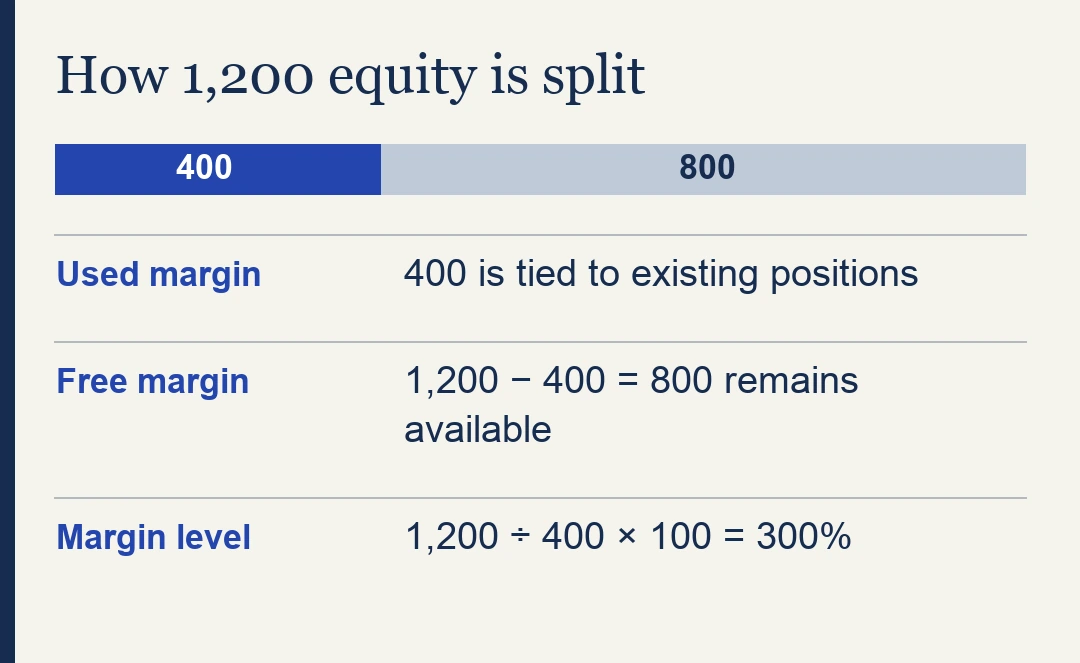
How 1,200 equity is split
UK Help Centre: meaning and calculation of free marginHow do the calculations work in one currency?
These formulas illustrate the terminal terminology; they do not replace the rates, margin requirements or definitions in your agreement. Keep every money figure in the same account currency before calculating. The resulting margin-level percentage has no currency unit.
- Start with a balance of USD 1,000, no credit and unrealised profit of USD 200 on open positions.
- Calculate equity: USD 1,000 + USD 200 = USD 1,200.
- If used margin is USD 400, calculate free margin: USD 1,200 − USD 400 = USD 800.
- Calculate margin level: (USD 1,200 ÷ USD 400) × 100% = 300%.
Why do the figures move, and what does zero used margin mean?
Suppose the unrealised profit in the example becomes an unrealised loss of USD 200, while the closed balance remains USD 1,000 and there is still no credit. Equity becomes USD 800. If used margin remains USD 400, free margin becomes USD 400 and margin level becomes (USD 800 ÷ USD 400) × 100% = 200%. These movements can occur without a deposit, withdrawal or closed trade because open-position valuation changes; used margin can also change when positions or margin requirements change.
If used margin is zero, the margin-level formula requires division by zero and is mathematically undefined. A terminal may show a blank, dash, zero or another display convention. Do not calculate a percentage by dividing by zero or treat the display as proof of unlimited safety. Check whether positions are actually open; when no margin is used, free margin still equals equity.
How should you read stop-out information without mixing regions?
For UK retail clients, the UK Help Centre specifies a 50% stop-out level, with automatic closure beginning with the position showing the largest loss. Stop-out does not guarantee that losses will be limited to the initial investment because market conditions can change rapidly. The APAC international service uses a 20% stop-out level, which is not a UK or South African threshold. South African readers should check the documents and terminal information applicable to their own account for the stop-out level that applies to them.
For an existing-account discrepancy, save dated terminal statements and screenshots showing the figures and account currency. Raise the issue through the entity and formal process in the applicable agreement. The UK site lists complaints@vantagemarkets.co.uk for complaints; the South African contact table lists support@vantagemarkets.com for complaints and support-za@vantagemarkets.com for licence enquiries. Include the account reference, dates, the figures questioned and the explanation sought. Never send passwords, PINs or identity documents to this manual.
Sources
- APAC international help: meaning and calculation of margin levelapac.vantagehelpcenter.com
- APAC international help: meaning and calculation of free marginapac.vantagehelpcenter.com
- APAC international help: difference between balance and equity in MT4/MT5apac.vantagehelpcenter.com
- APAC international help: stop-out and its calculationapac.vantagehelpcenter.com
- UK Help Centre: meaning and calculation of margin levelhelpcenter.vantagemarkets.co.uk
- UK Help Centre: meaning and calculation of free marginhelpcenter.vantagemarkets.co.uk
- UK Help Centre: difference between balance and equity in MT4/MT5helpcenter.vantagemarkets.co.uk
- UK Help Centre: stop-out and its calculationhelpcenter.vantagemarkets.co.uk
- FCA warning concerning the international Vantage Markets domainwww.fca.org.uk
- FCA clone warning identifying the genuine UK firm and domainwww.fca.org.uk
- UK legal documents and regulations applicable to UK accountswww.vantagemarkets.co.uk
- UK Vantage contact and complaints detailswww.vantagemarkets.co.uk
- South African regulations: intermediary, product supplier and account counterpartywww.vantagemarkets.com
- FSCA financial services provider searchwww.fsca.co.za
- South African Vantage contact details for licence enquiries and complaintswww.vantagemarkets.com